
Share
What's the difference between 3-Axis, 4-Axis and 5-Axis Machining
A fully equipped 5 axis CNC machine shop will have a range of state-of-the-art 3-axis, 4-axis, and 5-axis milling machines. When designing a CNC machined part, you may not have thought about which type of machine your part will be machined on, but the complexity and type of geometry you can design will be different for different types of machines. As a designer, having an understanding of which type of machine your part will be manufactured on is critical in optimizing your design.
The main difference between 3-axis, 4-axis, and 5-axis machining is the complexity of the movement both the workpiece and the cutting tool can move through, relative to each other. The more complex the motion of the two parts, the more complex the geometry of the final machined part can be.
A review of the functionality of each machine will help in your understanding of the ability of the machine and how it affects your design process.
What is 3-Axis Machining?
The evolution of 3-axis milling began as the practice of rotary filing with teeth on a cog-wheel operating on two axes only to automate manual filing. Over many years it became the manual milling practice on three axes, the X, Y, and Z, we know today. In three-axis machining, the workpiece remains still while the cutting tool moves along the three axes to mill the part. These three axes include horizontal movement front to back, and side to side, and vertical movement up and down.
This is still one of the most widely used techniques to create mechanical parts and can be used for automatic/interactive operation, milling slots, drilling holes, and cutting sharp edges. Because 3-axis machining only operates on three axes, it’s a relatively simple process that serves a variety of single planar needs.
While it is a more basic machining process, 3-axis machining may be ideal for your machining project depending on the size of your production run, the workpiece requirements, accuracy and finish constraints, materials used, and your holding capabilities.

What is 4-Axis Machining?
As the name implies, 4-axis milling involves the same processes as 3-axis machining, where a cutting tool is used to remove material from a piece to create the desired shape and profile. However, in the case of 4-axis machining, milling is performed on an additional axis.
A 4-axis CNC machine operates on the X, Y, and Z axes like a 3-axis machine, but it also includes rotation around the X-axis, which is called the A-axis. This is the fourth axis that’s added to our machining process. And this introduces the movement of the workpiece, rather than just the cutting tool. In most cases, the workpiece will be rotated to allow for cutting to occur around the B-axis.
This movement is useful when holes and cut-outs need to be made on the side of a piece or around a cylinder. 4-axis machining allows milling on all four sides of a workpiece in a single run. And it introduces the ability to cut angles off the 90-degree plane. They can provide quick and efficient work based on computer numerical inputs for precise results. Without this additional feature, the workpiece would need to be removed from the machine and reset with new workholding and design for a second operation. The 4-axis machining ability improves efficiencies greatly when a design includes milling to multiple sides of a workpiece.
What is 5-Axis Machining?
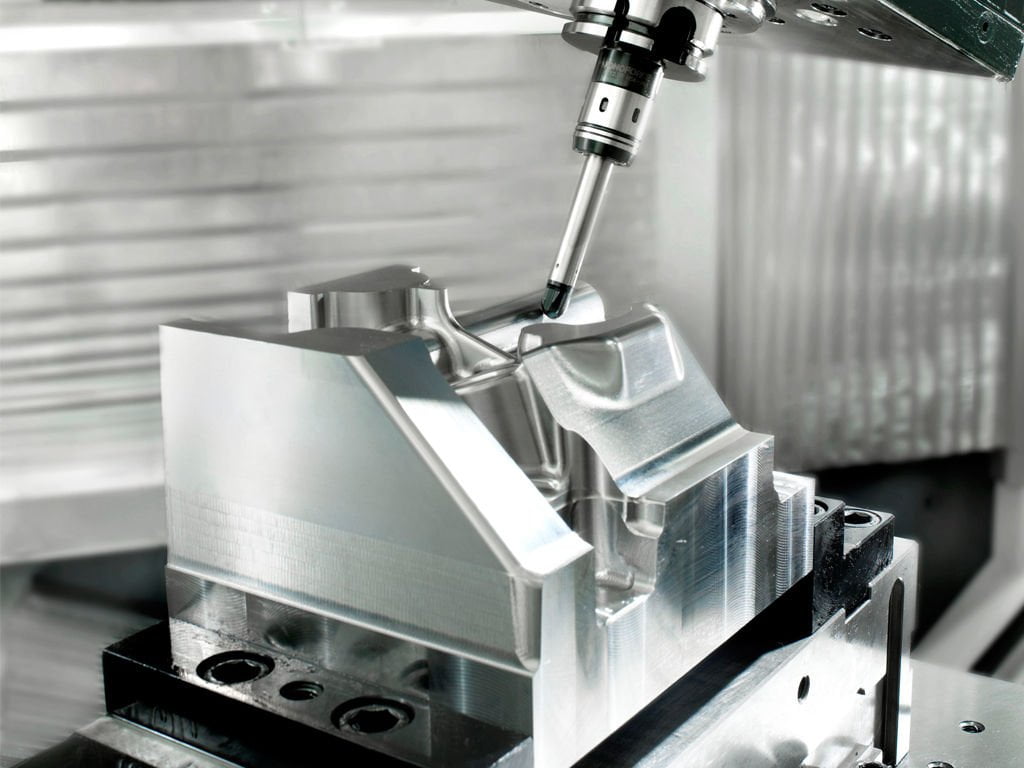
The best milling machines available today are the 5-axis machines. They are capable of creating precise and intricate parts for artificial bones, aerospace products, titanium pieces, oil and gas machine parts, car molds, medical, architectural, and military products. In 5-axis machining, all the axes of 4-axis machining are utilized, with an additional rotational axis.
The fifth axis in the 5-axis milling machine is around the B-axis, which rotates around the Y-axis in the X-Y-Z plane. Where the cutting or drilling on the B-axis was only available from the movement on the A-axis in 4-axis milling, this multidimensional rotation and tool movement allows for B-axis unparalleled precision, finish and speed in the production of a piece.
Intricate geometric patterns previously only available in molding can now be tooled with movement on a variety of angled planes. 5-axis machining can create very complex parts, which is why it is so important for high-level uses, such as aerospace applications.
However, 5-axis machining is also becoming more popular because it reduces lead time with single-step machining, provides more precise finishes, and greater accuracy. It also allows better access to the part geometry, which can utilize shorter tools and improve both the tool life and efficiency of the process by tilting the table for the ideal cutting position.
This overview of 3-axis, 4-axis, and 5-axis machining provides an overview of the approach to your part design. Cost of equipment is an obvious factor, but once design begins to incorporate cutting and finishes on multiple planes, the cost of human error, re-tooling, and tool breakage become more important factors over the lifespan of your operations.
Check our blog on the benefits of 5-axis machining for even more information on this efficient machine-shop master.
Get in touch with us to see what is possible
