
Which Automation Approach Fits Your CNC Machine Shop?
Share

CNC machining automation is no longer a one-size-fits-all approach. Since technology is developing quickly, you can develop strategies for your CNC machine shop. Choosing the appropriate automation is essential for boosting productivity, cutting labor expenses or running a 24/7 production. This blog looks into several automation tactics, like financial implications, equipment capacities and capabilities.
Statistics.
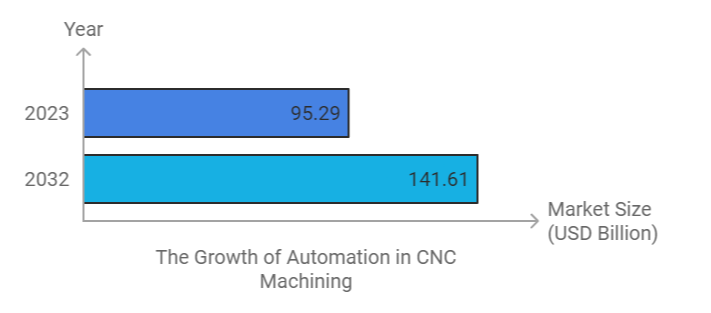
The Growth of Automation in CNC Machining
According to Yahoo Finance Article
- Market Size (2023): Valued at USD 95.29 billion.
- Projected Market Size (2032): Expected to grow to USD 141.61 billion.
- Growth Rate: Compound annual growth rate (CAGR) of 4.5% from 2024 to 2032.
Balancing Cost and Return on Investment
Since automation requires capital and the budget is crucial, the degree of integration and complexity of the system have a significant impact on the cost of automating a CNC machine shop. Let me explain:
- Basic Automation: The cost of basic solutions, such as pick-and-place cobot systems or bar feeders, can range from $20,000 to $50,000.
- Mid-Level Automation: Investing $50,000 to $150,000 can be used to add a cobot pallet changer.
- Higher Level Automation Over $250,000 can be spent on fully integrated systems with several robots, automated material handling, and real-time monitoring.
Even with the high initial expense, there may be a significant return on investment. Automation-adopted shops claim productivity gains of 30% to 40% on average, with some seeing payback in as little as two years. It’s critical to weigh the initial expenditure against possible labor cost reductions, higher output, and decreased downtime.
Pros and Cons of Automation in CNC Machining
Before embarking on automation, it’s essential to weigh the pros and cons.
Pros:
- Increased Productivity: Automation makes processes more efficient and increasing production.
- Consistency and Precision: Automated systems minimize human error, ensuring consistent quality and precision.
- Labor Savings: Automation can reduce the need for manual labor, allowing skilled workers to focus on more complex tasks.
- 24/7 Operation: Lights-out machining enables continuous operation, maximizing machine utilization.
Cons:
- High Initial Cost: The initial investment can be a barrier for smaller shops.
- Complex Integration: Deploying automation requires substantial planning and can disrupt operations.
- Maintenance and Training: Automated systems require ongoing maintenance, and operators need training to handle and troubleshoot these systems.
Machine Capabilities.
Not all CNC machines can be automated equally. But most modern CNC machines are designed with automation in mind, featuring built-in interfaces for robots and other automated systems.
- Input/Output or I/O Capabilities: Machines with strong input/output options can more easily integrate with automation equipment, enabling seamless communication.
- Software Compatibility: CNC machines that support advanced software solutions, such as CAD/CAM integration and real-time monitoring, are better suited for automation.
- Rigidity and Precision: High rigidity and precision are crucial for maintaining quality in automated operations, especially at high speeds or in lights-out conditions.
Retrofitting may be an option if your current machines don’t have these features, but it will increase the overall cost and complexity of the automation project.
The Role of Cobots in CNC Automation
Collaborative robots, or cobots, are transforming CNC machine shops with their flexible, cost-effective automation solutions. Unlike traditional industrial robots, cobots are designed to work alongside human operators, offering several benefits:
- Ease of Programming: Cobots typically have user-friendly interfaces, allowing operators to program them without extensive robotics knowledge.
- Safety: Cobots are equipped with advanced sensors and safety features such as Inherent safety sensors will stop when physical contact is detected, enabling them to work safely alongside humans without protective barriers.
- Versatility: Cobots can be easily reprogrammed and redeployed for different tasks, making them ideal for shops with varying production needs.
- Plug and Play with CNC Machines: Cobots can handle tasks like loading and unloading parts or operating multiple machines simultaneously. Their I/O capabilities allow for seamless communication with CNC machines, ensuring synchronization.
Conclusion
The correct automation approach for your CNC machine shop depends on factors like budget, production needs, and available equipment. Whether you need basic automation or a fully integrated system, the benefits of increased efficiency, precision, and cost savings can be significant. Cobots, with their evolving technology, offer a practical way to increase automation, even on a limited budget. Consider your shop’s unique requirements and invest in an automation solution that will position you for long-term success in a competitive market.
Three Questions to Consider
- What are the current inefficiencies in your CNC machine shop that could be addressed through automation?
- Is your existing CNC equipment capable of integrating with automation technologies, or will it require upgrades or retrofitting?
- How does your budget align with the different levels of automation, and what is your expected return on investment?
Actionable Steps
- Conduct a Needs Assessment: Evaluate your shop’s current workflow, pinpoint areas where automation could enhance productivity, and identify potential bottlenecks. This assessment will help determine the type of automation that best suits your needs.
- Budget Planning: Analyze your budget to see what level of automation you can afford. Consider the initial investment and calculate the potential ROI by estimating how much automation could save in labor costs and increase production efficiency.
Consult with Automation Experts: Reach out to vendors or consultants who specialize in CNC automation. They can help you evaluate your existing equipment, recommend suitable automation solutions, and provide a roadmap for implementation that minimizes disruption to your operations.
You may also like

5 Critical Design Mistakes That Increase CNC Machining Costs (And How to Avoid Them)
When designing parts for CNC machining, many engineers focus solely on functionality while overlooking how design choices impact manufacturability and cost. At Rapid Enterprises,

From Aluminum to Titanium: How Material Selection Affects CNC Machining Costs
CNC Machining has been stated to be one of the most versatile methods of production, but converting it into a cost-effective one requires something more than mere machinery that is optimized. One factor that goes unnoticed most of the time is the material selected.

The Future of Manufacturing: Adapting to a Decade of Disruption and Innovation
A decade ago, manufacturers faced potential threats like rising wages in low-cost regions, fragmented customer demand, and a scarcity of skilled talent. The Great Recession of 2008–2009
