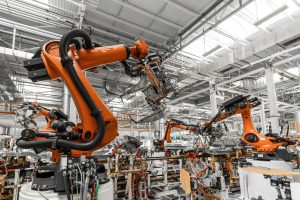
The Risks of Adopting IIoT Industrial Internet of Things revolution of Industry 4.0 continue to affect major changes in businesses from retail stores to large manufacturing facilities. This fast, blossoming world of automation pairs well with the data exchange offered by the Industrial Internet of Things (IIoT). Cloud computing, robotics, and computer integrations are changing potentially every aspect of business. With every revolution, there are benefits and challenges. A clear strategy is needed for introducing any change into your CNC manufacturing business. An assessment of clear advantages must be weighed against the risks of adopting IIoT. We reviewed the advantages in a previous article. Today we look at the challenges and the risks as they may affect your machine shop.
Benefit Review
Creating a smart factory with streamlined processes is the dream of every manufacturer. Newer equipment can convert easily to robotic processes, but even the earliest adaptation of CNC machines to work with CAD/CAM systems can utilize shared data systems. Some changes can be quite fluid, such as adding a simple sensor. Some can be more complex like just-in-time delivery processes for inventory control and integrated robotics to maximize safety and efficiency on the shop floor. When implemented properly IIoT can optimize automation. That proper implementation is imperative to avoid huge financial investment for little gain. It can provide opportunities for safer working conditions and advancement for staff. A better product can be produced in less time. All parts of your business can communicate. When the time is right to move ahead an equal emphasis must be placed on people, machine compatibility, data security, and ROI. A review of some of the associated risks should help you move with confidence into the optimization of your automation.
Cyber Security
The threat of internet security has long been a concern for banks and retail stores where financial transactions occur. As more businesses add digital programming the risks to all organizations become greater. IIoT can offer remote reporting of production for enables lights-out manufacturing. It can also manage inventory, scheduling, maintenance, quality control, and staff management to name but a few. Sharing data through digital streams makes CNC machining at risk of digital theft of client lists and designs, but hackers can also find their way into confidential staff or business information. The threat of viruses and malware can shut a business right down. The cost of internet security must be a consideration as you move further into cloud-based solutions. Internet security is often overlooked in many basic manufacturing operations, so the risk becomes even greater if it is not addressed when your business relies on internet data.
Staff Adaptation
Half of those polled in a Microsoft survey mentioned lack of training and talent were factors holding them back from adopting digital platforms. It is always important to invest in staff and change management is important when revising company operating systems, such as just-in-time delivery systems or service manufacturing. Staff culture must embrace and anticipate the benefits of the change. This requires work with staff up front to address their needs and questions. Staff training will help move potential talent into new positions. A combination of training and access to an outside talent pool is also important to be sure you can manage the proposed changes with qualified staff.
Moving ahead into a digitized world still relies heavily on staff capability to process and act on the data. A constant theme in CNC machining for decades has been a lack of skilled staff. The very problem of digitization can provide the solution with smarter software able to anticipate errors and alert users providing “on-the-job training”. Moving ahead into new computer-driven data operations must have the staff to support it.
Cost
Many machine shops consider a complete investment in new equipment is required for a venture into smart factories. Just as many legacy machines could be converted to CAD/CAM production, many machines can be retrofitted for automation and digitization. New equipment may offer a range of sensors and feedback options, but perhaps most important to you is just vibration. Adding simple IoT solutions to legacy equipment can provide feedback data specific to your needs without facing added expense for functionality you don’t need. Be sure, however, to check the compatibility of various third-party software, systems, and machines with all vendors working in harmony to maximize your ROI. Unexpected costs due to incompatibility of equipment can derail the simplest upgrade. The assessment and comprehension of ROI may require an outside consultant to realize the full potential of adding IIoT to your operations.
While companies may not be ready to address the cost to upgrade, others will falter when failing to apply the data the new technology will bring to the shop floor. Adding monitoring, cameras, and other automated tools is useless if you don’t apply what you learn to improve production, maintenance scheduling, and machine life. This brings us to: what do you need? Be sure you do a full assessment of what you have and what you need to employ to add value.
Smart factories will not replace people. They will move people into safer, analysis, and action roles working with the data to streamline processes. The risks of adopting IIoT are only based on a lack of knowledge and financing. Clear benefits are present if the time is taken to assess needs and develop a clear plan over many years. The small CNC machine shop can find the same benefit as a large automated production line when each step is researched and customized to suit their unique operational needs.